About the destination:
Explore Fakarava through our different themes. Discover the richness of our blog and dive into the heart of our exciting topics.

Discover Fakarava in pictures:
Let yourself be carried away by the beauty of Fakarava through a collection of captivating images. Explore the diversity of its landscapes and the richness of its culture.
What strikes Fakarava is the simplicity of life. No big hotels, no crowds, no unnecessary noise. The days are organised around the sun, tides and wind. The evenings are quiet, often illuminated by the stars, with the sound of the surf as a background.
The airport:
Fakarava Airport is an essential infrastructure for the operation and development of the atoll. Located on the main motu, 15 minutes from the village of Rotoava, it is the main link between Fakarava and the island of Tahiti, as well as with other Polynesian archipelagos. With a single runway of about 1,400 metres, the airport can accommodate ATR-type aircraft used for inter-island connections, mainly operated by Air Tahiti, and Air Moana recently. They play a fundamental role in the daily lives of residents by ensuring the transportation of people, goods and essential services.
On site, you will find a dining area, toilets and you can wait for your flight by the sea.
Don't forget to plan a transfer, either by "truck" or by car for the most familiar.


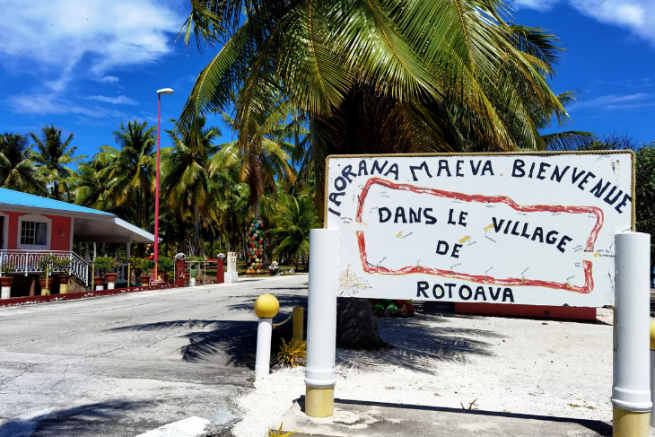
The village Rotoava
Rotoava is the main village of Fakarava Atoll, located on the north coast, between the ocean and the lagoon. It is here that you arrive by plane, that you disembark with your suitcases, and that you immediately feel the particular rhythm of the Tuamotu: slow, peaceful, deeply connected to the sea. The village stretches along a unique road, lined with coconut trees, colourful houses and carefully maintained gardens. In Rotoava, everything is done on foot or by bike. The village is small, but well organised: there is the school, the town hall, the dispensary, some shops, the post office and several family pensions.
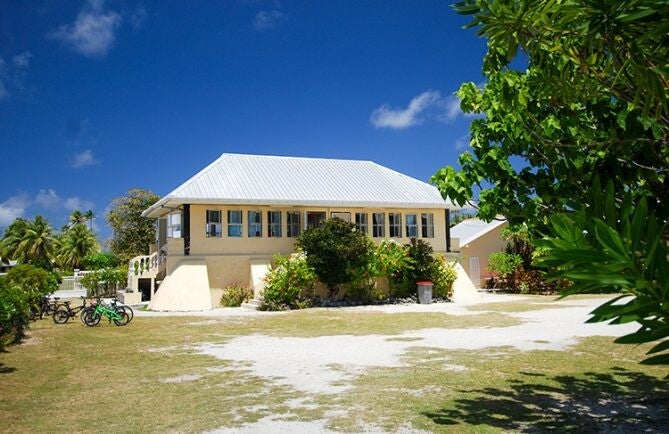
In Rotoava, everything is done on foot or by bike. The village is small, but well organised: there is the school, the town hall, the dispensary, some shops, the post office and several family pensions.
Here, the social bond is strong, sincere, and punctuated by collective events: parties, masses, plane arrivals or fishing returns.
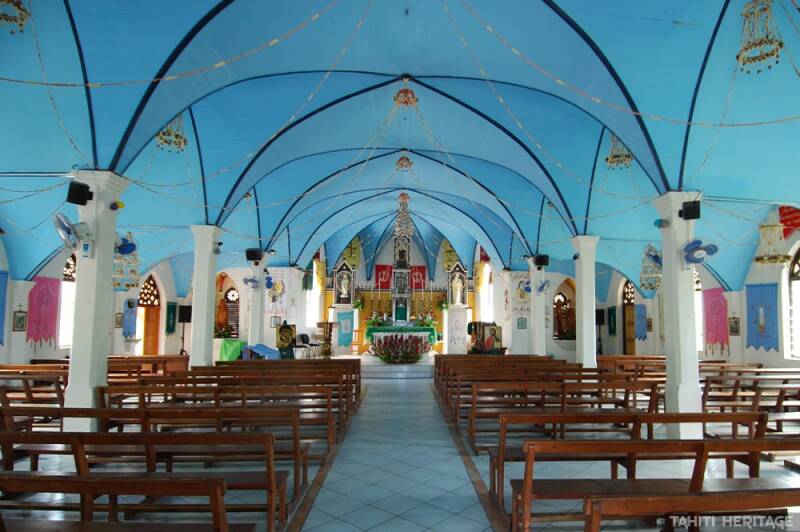
The life of the village is deeply marked by Polynesian culture and the Christian religion. The church occupies a central place, not only as a place of worship, but also as a gathering space. The songs, often polyphonic, resound throughout the village during the services, especially on Sundays. Traditions, the paumotu language and respect for the elders remain very present in everyday life.
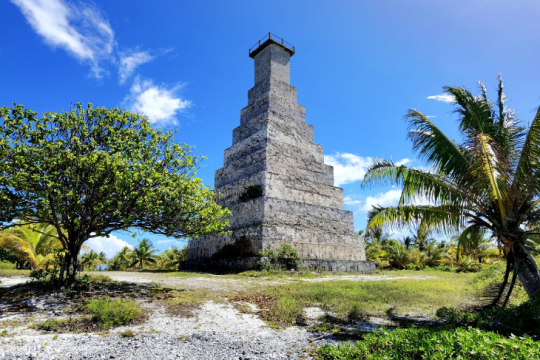
The Rotoava lighthouse is an essential landmark for maritime navigation. Modest in size but fundamental in its role, it watches over the entrance to the lagoon and guides the boats that circulate between the ocean and the calm waters of the atoll, especially near the north pass of Garuae.
In addition, it is distinguished by its simplicity. It is not an imposing monument, but a functional structure, perfectly integrated into the landscape. During the day, it blends into the decor of the lagoon and coconut trees; at night, its light becomes a reassuring signal, visible from afar, which recalls the proximity of the earth and the safety of the passage.
The North Pass
The Garuae Pass is the widest pass in French Polynesia. A true marine highway between the ocean and the lagoon, it is known worldwide for the exceptional density of sharks, the power of its currents and the diversity of its fauna. Each spot has its own identity, linked to current, depth and relief.
During incoming drift dives, we settle near the bottom to observe a real wall of gray sharks, sometimes several hundred individuals lined up facing the current. The show is striking, almost hypnotic. We also meet white-pointed sharks, barracudas and large schools of carangues. This site is reserved for divers who are comfortable with electricity.
The coral garden has a softer current and the decor consists of colourful corals, coral potatoes and white sand. There is a wide variety of tropical fish, napoleons, pastenague rays and sometimes nurse sharks. It is an ideal spot to relax after a more engaged dive.


The South Pass

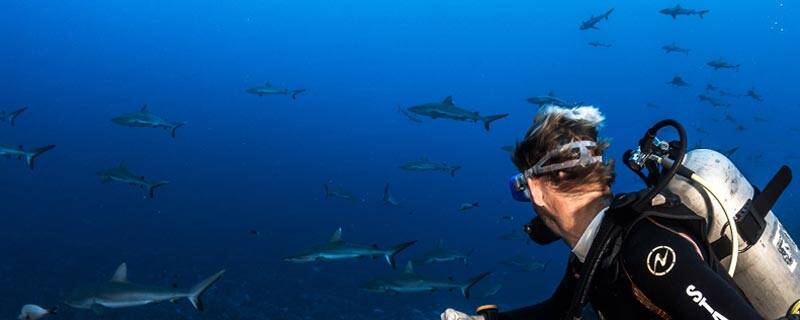

When you live in Fakarava, the South Pass, you don't just see it as a world-famous dive spot. For us, it is a living place, almost a member of the family. We have known it since childhood, we fish there, we go there by boat, we respect it. She has a strong character, sometimes calm, sometimes impressive, but always predictable when we know how to observe her.
In the southern pass, what strikes first is the amount of sharks. They are there every day. Especially gray sharks, but also white tips, nurses, and sometimes hammers. They are not aggressive, they are part of the decor. We see them lined up facing the current, letting themselves be carried away, as if they were watching the entrance to the lagoon. For us, it's reassuring: when the sharks are there, it's because the lagoon is healthy.
What makes the southern pass so special is the reproduction of groupers. At certain times of the year, especially around the full moon, hundreds, sometimes thousands of groupers gather in the pass to spawn. It is a rare, almost sacred natural event. The whole chain of life is set up: groupers, sharks that revolve around, caranguses, barracudas. We then know that the pass is active, that it plays its role.
Créez votre propre site internet avec Webador